Why the Engineers Who Should Be Writing Docs Are the Ones Who Never Do
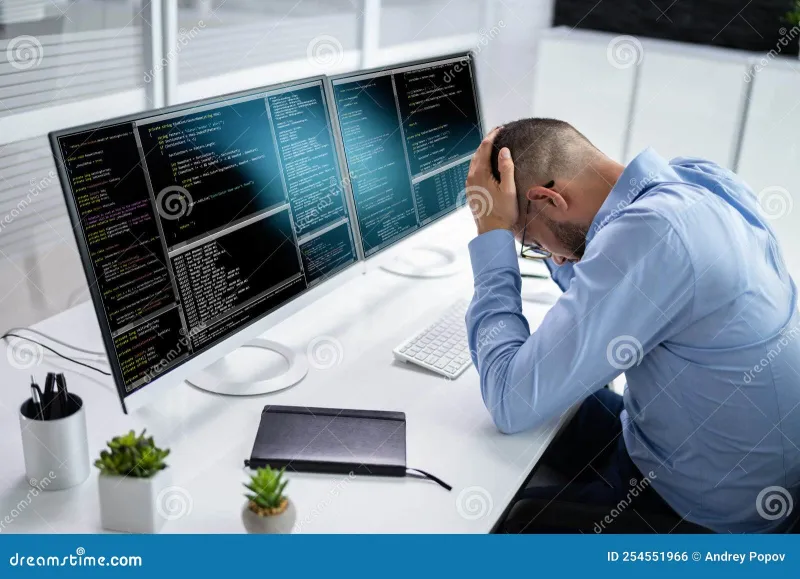
Photo: frustrated software engineer staring at laptop screen thinking, via thumbs.dreamstime.com
Here's a scenario that plays out on engineering teams across the country every single week: a senior developer ships a beautifully architected feature, merges the PR, and then... nothing. No docs. No inline comments beyond the bare minimum. No README update. When someone on the team finally asks about it, the senior dev gives a five-minute verbal explanation that is immediately lost to the void.
Ask that same developer whether documentation matters, and they'll tell you it absolutely does. They've been burned by missing docs. They've spent entire afternoons reverse-engineering someone else's undocumented code. They get it. So why won't they write it?
The answer isn't what most engineering managers assume.
It's Not Laziness—It's a Feedback Loop Problem
Software development is addictive in a very specific way: you write code, you run it, something happens. The feedback is immediate, tangible, and often satisfying. Documentation doesn't work like that. You write a detailed explanation of a system, push it to the repo, and... crickets. Nobody emails you to say the docs were great. No metrics spike. No green checkmark lights up.
For developers who are wired to optimize and iterate based on feedback signals, writing documentation feels like shouting into a void. The effort is real. The reward is invisible. Over time, that equation trains even the most conscientious engineers to deprioritize it.
Teams that understand this don't just ask for better docs—they build feedback mechanisms. Internal doc analytics, shoutouts in team standups when someone's documentation saves the day, even something as simple as a Slack channel where teammates post "this doc just saved me two hours" can rewire the incentive structure.
The Status Problem Nobody Wants to Talk About
Let's be honest about something that rarely makes it into retrospectives: on most engineering teams, documentation carries low social status. The people who are celebrated are the ones who ship features, close incidents fast, and architect elegant systems. Nobody gets promoted because their README was exceptional.
For ambitious, talented engineers—the exact people whose knowledge is most worth capturing—spending time on docs can feel like opting out of the work that actually advances their career. It's not irrational. It's a rational response to the incentive systems most companies have quietly built.
The fix here is organizational, not individual. Engineering leadership has to make documentation visible as a contribution. That means including it in performance reviews with actual weight, not as a checkbox. It means publicly recognizing engineers who improve internal knowledge infrastructure. And it means senior leaders modeling the behavior—if your staff engineers and principal engineers never write docs, nobody below them will either.
The Blank Page Is a Different Kind of Hard
Here's something that surprises a lot of non-technical managers: the same developer who can architect a distributed system from scratch will sometimes freeze completely in front of a blank documentation template. Writing is a different cognitive skill than coding, and many engineers—especially those who came up through CS programs that didn't emphasize technical writing—find it genuinely uncomfortable.
This isn't a character flaw. It's a skills gap, and it's one that organizations can address directly. Structured documentation templates help enormously. When a developer opens a new doc and sees clear section prompts—"What problem does this solve?", "How does a new team member get started?", "What are the known limitations?"—the activation energy drops significantly. They're filling in answers, not staring at a cursor.
Pair-documenting is another underused tactic. Have a developer walk a teammate through a system verbally while the teammate types. The developer gets to stay in their comfort zone (talking through technical concepts), and the documentation gets written. Refining it afterward is much easier than creating from scratch.
Timing Is Everything
One of the most common documentation mistakes teams make is treating it as a post-ship task. By the time a feature is deployed, the developer's mental context has shifted. The decisions that seemed obvious during implementation are already fading. The edge cases that got worked through at 11pm on a Tuesday are gone.
Documentation written immediately after (or better, during) development is faster to write and significantly more accurate. Teams that integrate docs into the definition of done—not as a bureaucratic formality but as a genuine part of the ship checklist—consistently produce better knowledge artifacts than teams that treat it as cleanup work.
Some teams go further and experiment with doc-driven development, where the documentation is drafted before the code is written. It sounds counterintuitive, but it forces clarity about what a system is supposed to do before anyone writes a single function. The doc becomes a contract, and the implementation becomes the proof. It's a shift that takes some getting used to, but teams that adopt it often report that it makes both the docs and the code better.
Making It Part of the Culture, Not the Chore List
The teams that crack this problem aren't the ones that send the sternest reminders about updating the wiki. They're the ones that make documentation feel like a natural extension of doing good work.
That shift usually starts with a few specific moves: integrating documentation tooling directly into the development workflow (so docs live next to the code, not in a separate system nobody checks), making it easy to contribute incrementally rather than requiring complete guides, and creating a culture where pointing out missing docs is celebrated rather than seen as complaining.
On platforms like PlatformDoc, the collaborative nature of open documentation already does some of this work. When docs are visible, editable, and genuinely used by the team, they stop feeling like a solo chore and start feeling like a shared resource worth investing in.
The goal isn't to turn every engineer into a technical writer. It's to lower the barriers enough that the engineers who know the most find it natural—not painful—to share what they know. That's a culture problem. And like most culture problems, it responds to consistent, visible leadership more than it responds to process.
Your best engineers aren't avoiding documentation because they don't care. They're avoiding it because the systems around them haven't given them a good reason to prioritize it. Change the systems, and the behavior tends to follow.